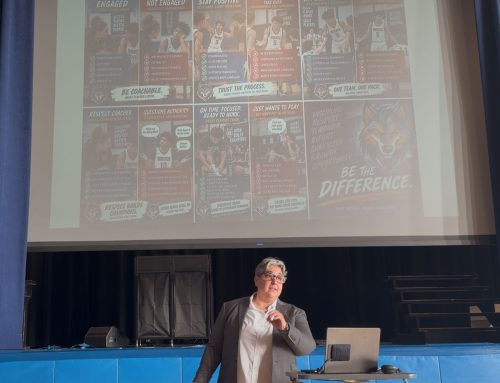
Below is a summary of the key points shared during Gerry Doyle’s recent session on career exploration, future-ready skills, and the long-term support Wolcott aims to provide for students and alumni. The conversation touched on how we’re building a structured, multi-year approach to career development, the role of AI and emerging tools, the importance of skills-based learning, and the ways families and the broader Wolcott community can help students grow their confidence and pathways over time.
This is just an initial conversation. I’m happy to meet one-on-one with Wolcott families to set up specific plans in collaboration with your student’s learning strategist, so we can map out how to continue this work. One of the things we’re hoping to build is a kind of ten-year “accompaniment.” While your student is at Wolcott, they’re thinking about their future. Then they move into college, university, or a gap year. After that, they enter the early stages of their career, roughly the first one to five years. We want this long-term, career-focused support to be a distinguishing part of a Wolcott education, something your family receives as part of this community.
Right now, all of this is simply built into being at Wolcott. These services are part of your experience as current families, and the support we offer Wolcott alumni is also complimentary. In general, I find that with three to four conversations I can help someone get on track — and create some momentum in their job search and career exploration; however, our collaboration will continue until such time as they feel that they have established forward movement such that they are able to self-direct their forward-progress. Bottom line: I stick with folks until they land where they want to be and that “they’ve hired the job or the portfolio of experiences” that will help them get to what’s next in what matters to them.
By background, I’ve spent about four and a half decades in higher education: the University of Chicago, Harvard, the Tuck School of Business at Dartmouth, Emerson College, and Illinois Institute of Technology. For the last twenty years, I’ve focused more and more on helping people think through their careers. Since around 2000, I’ve been deeply involved in career services, career development, and leadership development. I also layer in some financial literacy. In addition to my work in higher education, I also work with a number of startups in the workforce and human development space.
My connection to Wolcott goes back to its founding. I was here early on recruiting students, and then I joined the faculty part-time, teaching business and entrepreneurship, applied economics, and an internship course. Under Miriam and Marisa’s leadership, I transitioned into this current role.
I want to share a few observations from the last six to nine months working with Wolcott students and also with people beyond Wolcott. I currently work with about a hundred individuals. Most of this work is pro bono.
One major theme is that AI is not going away. It will eliminate some jobs, but more importantly, it will become a tool that people need to understand and use, much like Excel or Grammarly or any other standard tool. You have to be smart about it. When people first start using AI tools like ChatGPT or Claude, they often use them in a lazy way. They haven’t yet learned how to frame prompts, how to engage critically, or how to maintain their own voice. So, AI is here to stay. It’s a challenge, but also an opportunity, and we need to think carefully about how to help young people use it well.
Another framework I use with students and adults is called “Jobs to Be Done.” Most people think, “I’m going out to look for a job.” I try to reframe that: you’re not just looking for a job, you’re looking for a job that will teach you something, help you learn, and help you build a network that leads you somewhere else. So the question becomes: where do you want to go next, and what job are you “hiring” to help you get there?
I’ve talked with Marisa and others at Wolcott about applying this thinking here too. When students join the track club, for example, they’re not just “doing track.” They’re also “hiring” track to learn discipline, resilience, teamwork, time management. The same is true in math, in basketball, in clubs, in arts, and so on.
One of my hopes for Wolcott is that we begin to map out the skills, aptitudes, and capabilities students are building in everything they do. Skills-based hiring is not going away. When students write résumés or introduce themselves, they need to be able to say, “Here are the skills I’ve developed and how I’ve applied them.” We also need to recognize that not everything a student wants to learn will be offered directly at Wolcott. One thing you can use learning plan meetings for is to say, “Here are additional skills I’d like to develop.”
Another challenge for young people is the future of work itself. Today, graduates are likely to have 10, 15, maybe 20 different jobs. For young people, it can be daunting to realize they will probably reinvent themselves several times over a lifetime. So part of the work is to reframe this as something that can be exciting, not just scary: How do I build capabilities so that I can navigate change?
If you go into the toolkit, you’ll find a resource on 43 “healthy finance habits.” These are general, practical ideas, many of them created with Wolcott students in mind.
In the job search process more broadly, referrals matter. If you apply cold to a job, your odds of getting noticed can be one in several hundred. But if you’ve had a conversation with someone at that organization, if someone can make an introduction or vouch for you, your chances rise significantly. People often “comfort” themselves by saying, “I applied to ten jobs today.” It feels productive, but the real work is building relationships, having conversations, and learning how to “audition” for work.
Whenever I set up conversations of inquiry for Wolcott students, I never throw them in cold. I’m always on the Zoom or in the room. Until they graduate from Wolcott, they don’t do this alone. Every communication I have with a student, I copy their parents and their learning strategist. There’s nothing secret here; it’s fully transparent and designed to be safe.
I also help them think about building “tiers” of community: peers, faith communities, neighborhoods, clubs, alumni networks, and so on. The more we can get students into “slipstreams” where there is momentum—places where people are already moving in the direction they want to go—the better.
I’ve spoken with Vincent and Marisa about also offering open office hours for parents. Another thing we can do, with the help of the Parents Association, is crowdsource opportunities. If a student is interested in architecture, historic preservation, and changing communities, for example, I’d like to be able to ask, “Who do we know in that field?” My guess is that within the Wolcott community we could find someone connected to almost any dream a student might have.
I also have some specific ideas tailored to grade levels. For ninth and tenth graders, it might be about creating a first email signature and a first résumé, even if they’ve never had a paid job. For eleventh and twelfth graders, we can build on that with LinkedIn profiles, summer internships, and preparing for job or college interviews.
It really is a promising time. Students can create things that have real impact. But those early steps—“How do I start?” “What do I say?” “Who do I talk to?”—can feel daunting. That’s where this kind of structured support matters.
So, that’s a little bit of what we’re trying to build here at Wolcott. Want to learn more about how Wolcott College Prep supports students and alumni with career readiness while in high school, college or while they are entering the job market? Email gdoyle@wolcottschool.org.