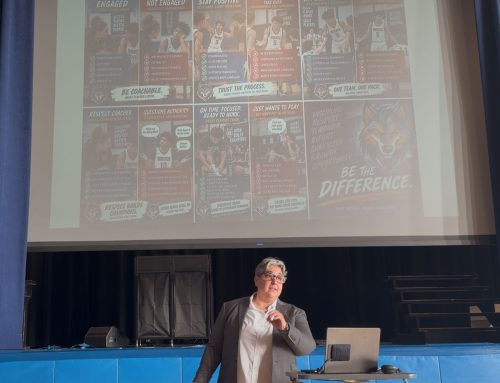
Wolcott College Prep’s Tyree Institute welcomed Dr. Christina Cipriano—author, researcher, and director of the Education Collaboratory at Yale University—for an evening that challenged the audience to rethink patience, justice, and the systems that shape learning.
Dr. Cipriano, joined in conversation by Dr. Kimberly Schonert-Reichl, the NoVo Foundation Endowed Chair of Social Emotional Learning at UIC, shared insights from her new book, Be Unapologetically Impatient. Drawing from her research in learning science and her lived experiences as a parent and advocate, she urged educators and families to reject the notion that “this is just the way things are” and instead act with purpose and empathy to create meaningful change.
Throughout her talk, Dr. Cipriano blended scholarship with storytelling—illustrating how emotional intelligence and gratitude can interrupt systemic inequities in education, healthcare, and beyond. She reflected on her own journey navigating schools and medical systems with her children, showing how curiosity, compassion, and courage can transform frustration into advocacy.
Dr. Schonert-Reichl praised Cipriano’s rare ability to connect rigorous academic research with real-world humanity, calling her “one of those rare people who moves seamlessly between scholarship and fierce advocacy.”
The evening concluded with a book signing and conversation among faculty, families, and community members about how to bring Cipriano’s message to life at Wolcott and beyond.
Dr. Cipriano’s call to action was clear: “We don’t have to wait for systems to change to do better for our children. We can begin today—one conversation, one choice, one act of empathy at a time.”
Watch the full conversation with Dr. Cipriano and Dr. Schonert-Reichl below to experience the full impact of this powerful event.
TRANSCRIPT FROM THE VIDEO:
Marisa German, Head of School
Good evening and welcome everyone. Wolcott is a college prep high school designed for students with learning differences using a strength-based approach that honors student response. Tonight’s event, which is brought to you by Wolcott’s Tyree Institute, embodies that same spirit of innovation, unapologetic ambition for change. We’re gathered here because we believe that the way things have always been done isn’t quite good enough.
Tonight, we have the privilege of welcoming Doctor Christina Cipriano, associate professor at the Yale Child Studies Center and director of the Education Collaboratory at Yale University. Doctor Cipriano is an internationally recognized expert in the science of learning and development, bringing both rigorous scholarship and lived experience to work. Her groundbreaking new book, The Unapologetically Confessions, challenges us to reject the status quo and demand better using learning science, emotional intelligence, and gratitude as our tools for change.
And joining her in conversation is Doctor Kimberly Shorter Michael, the Nobel Foundation Endowed Chair in Social Emotional Learning and professor of psychology at UIC, whose research explores how to foster empathy, compassion, altruism and resilience in young people. Tonight, we’ll dive into darkness around his book and explore just what it means to be unapologetically impatient patients. Following our program as seven volumes of Brown will sign books and copies are available for purchase.
If you haven’t gotten there yet. So, without further ado, please join me in welcoming them.
Dr. Cipriano
Marissa, thank you so much for that generous introduction. Kim, thank you so much for being here today. Thank you to each and every one of you for taking time out of your schedule to be here. I know you have a lot of options with how you can spend your time, and I’m deeply honored that you’ve chosen to be here in community with us tonight.
With everything else that’s going on, so we can all live and learn together about our opportunities to do better in the service of all kids and families. So just thank you so much for being here. I heard there’s, like, a lot of traffic out there, and things can be a little hectic. I think there’s a baseball game.
Got a few things going on. Some bridge construction. So thank you for everything that you did to be here today. And I look forward to making this a very worthwhile conversation. And, Kim, thank you for taking time out of your schedule to be here, to be in conversation with me. I’m really looking forward to kind of digging in on the on the book together.
Yes, I’m so excited. But, before I begin with my large number of questions for you, I just want to hear a bit from you, from your book. Absolutely. So I’ll. I’ll, I’ll get us started. And just share. I’ll read a little excerpt from the from the beginning of the book to kind of get us going.
And before I do that, I need to say that it’s really hard for me to read a piece of the book and to skip anything. So, this is this is a, it’s a short form trade trade book, and I’m an academic. And so, like, every word counts, every word matters. And it was like, very thoughtfully and like poetically and designed with rhythm and rhyme and how I bring you all on the storytelling journey with me throughout the book.
And so when I I’ve learned this process of having the privilege of getting to share my book now as I’m going across the country, that it like hits me in a way, and I’m like, oh, but I want to just keep going and keep going. And so, anyway, I’ll, I’ll read a little bit and then we’re going to talk.
And I know Kim had some things that she really loved about the book that she wanted to bring to bear for the Wolcott community. And, yeah. So, with that, I will just kick us off with a little bit about the unapologetically impatient. So I’m just going to read a short piece from the opening of the book.
You don’t want to be like us and have to work any job you can when you grow up. My parents told my three siblings and me, you can do anything you want in life as long as you stay in school. Within education you can choose to do what makes you happy, they’d say. And since we can’t help you with your homework, you need to ask your teachers.
Your teachers are the experts, and school is there to help you. When you don’t understand something, ask, so I did. I asked my third grade teacher why I had to fit all my answers to questions. In the tiny lines on the worksheets I asked my sixth grade teacher why our school was closed for some holidays and not others.
I asked my junior high school assistant principal why we needed to buy our own calculators for math class, given they were required to access the math in our textbooks. And now I’m going to fast forward through. Okay, a few months later, I found myself starting a PhD in applied Developmental and Educational Psychology at Boston College and a certificate in Human Rights and International Justice, ABC Law School.
I was going to be a psychologist. I wanted to be the change I wanted to see in the world by doing research that involved school policies and practices. So for the next five years, I deeply studied how the science of learning and social emotional development could support all kids and communities to thrive. And while I learned how to think like a prevention scientist in my coursework, my understanding expanded most.
And I like to say this is where I fell in love. In working with in schools, with youth and educators who were all othered by the US education system, I taught youth with emotional and behavioral challenges who are relegated to windowless basements in abandoned public school buildings, taken over by the state youth with learning of youth learning and correctional facilities.
Youth who are wards of the state, residential programs medically complex youth in and out of exclusionary public school placements, and neurodivergent youth banished to hallways and trailers on the outskirts of their neighborhood public schools. I saw the best of humanity in their educators and support staff, colliding with a never ending sea of barriers to their students joy. All of these unfortunate experiences were laced with systemic prejudice, the systems designed to support the youth who had been positioned by society to be most in need of services and social support, were undeniably broken.
I asked anyone who would listen to me why from school administrators, district leaders, mental health professionals, parents, advocates, teachers, specialists, families and the students themselves. And the answer? It was always some version of it’s just the way we do things here. It’s just the way things are. These lessons I learned about how the system isn’t working for those deemed by society to need it most.
They came home for me when I became a mother. Seemingly overnight, I found my family on the receiving end of injustice, masquerading as common practice, as compliance, as standard procedure, as conventional wisdom, as a checkbox. And the injustices just kept getting uglier with each interaction I had. No matter the grain size, it did not discriminate me, be it at our kitchen table, the local playground, on the sidelines during a recreational soccer game, or at a national theme park.
It didn’t matter if we were at the doctor’s office for a wellness check or riding in the back of an ambulance again in route to the emergency room. It was in their elementary school classrooms around the table at the IEP meeting, at the school board meeting at the university and on the floor of the Senate. I heard it everywhere.
It’s just the way things are. It’s just the way we do things here. And I, we were expected to be patient with it. I’m going to skip. I’m going to skip. I’m going to skip. I have been thinking about writing this book for a long time, but what pushed me to finally sit down and do it was when our middles, Salvatore and Eleanor, started asking questions.
When Salvatore asked me why he had to hide for a drill at school, when Eleanor asked me why I call her neurodivergent a superpower, while a teacher told her disability is an illness. When they asked why we had to wait for another bus to accommodate their older brother Miles and his wheelchair when all the other families got to go ahead of us.
My children’s questions inspired me to a new level of realization why are we being so patient in the face of injustice? What are we waiting for? To be sure, nearly everyone believes that patience is a virtue, and in fact, it is one of few principles of correctness that communities across ideological divides agree on. But there is a distance between being polite and being right.
It is time to be unapologetically impatient in our pursuit of justice. I see this in my own life when navigating systems of education, health care, and industry that are not designed with my family and our needs, nor best interest in mind. And you can see this every day in the quiet experiences of all families who are navigating perceived disadvantages from disability, language, income, culture, education and the discrimination they encounter on the regular.
This book is my love letter to my children, my family and our generation. It’s for every person who has felt small and seen wrong. It’s for care providers and makers and dreamers and doers, the educators and the architects of a future that embraces a common humanity. It may take our lifetime to change how systems operate, and even how you and I are seen in the system.
But we can each harness the power in our positionality right now to interrupt the status quo. We can do it every day by prioritizing compassionate, empathetic inquiry. We can ask questions just like my dad taught me with the intention of calling people in, not out. We can share expertise in the form of lived experience in real time to affect change.
Just like I will share stories and illustrations to show you how each and every one of us can use evidence based strategies to build a future for all children and families. Now, when our patients manifest as complacency with injustice, we are waiting for systems change at the expense of our families. And I am not waiting for justice at the expense of my children.
And you do not need to either. It’s time to be unapologetically impatient. Let me show you how. Thank you.
Dr. Reichl
Wow. I just so honored to be here with you this evening, Chris, to talk about your book. I read it. I have to say, I’m a commuter on the train. I devoured it. It was like a feast. And where I really took in every morsel, every word. So I have to say, I really recognize that poetry.
I really felt like it was poetry. The way that you wrote it, in the way that you did the spacing and the lines, and you could talk a little bit more about that. I just you’re really my hero. I’ve told you this before, but like, now it’s like beyond, you’re my superhero. And, you have accomplished so much, and you have such, amazing humanity and, and passion for your children and for all children.
I do want to say, you know, just I wrote down a few remarks just to begin this. You’re really one of those rare people who can move between seamlessly, between scholarly work, academia and humanity and fierce advocacy. I mean, that’s what I see. You are fierce. You are the mama bear. Do you ever get told that you’re that I’m a.
So I just wanna make sure, your work in the area of social emotional learning. Your work in the area of understanding children with learning differences is really advance the field in ways, that so, so, so much so early in your career have made such an impact already, you know, and so this is so important because some of you might not know that that Chris really has made such an imprint on the field of social emotional learning.
So importantly and now with this book, you’ve taken things to a to a whole new level. And so I just, I could, I could go on. I have like, pages and pages and pages of we don’t need to do that. How amazing. Anyway, just you’re just incredible. I just hope everyone gets a chance to read this book and and really devour it.
And I feel like I want to go back and read different sections because I was going back, and. And I feel like I know all the kids. I can’t wait to meet them all. I really can’t, but, you know, my first question was really kind of what inspired you to write this book, but you already kind of told us what inspired you.
But it isn’t. It’s your children. But there must have been some other people who were behind you. You know, I really believe in that. You know, the Bobby quote, every everyone does works to their best ability when they have trusted others standing behind them. So I wonder, who were those for you?
Dr. Cipriano
Yeah, I love that question. So, yes, the kids questions were, you know, inspired the thought process there within of like, being like, I need to write this book and I need to write it now.
And, I guess about two years ago, I was at an academic conference, just like I’m in town right now in Chicago at an academic conference, I was at, a conference called IRA, and, I was meeting with publishers. And so I was like, I have this idea for this book. And I was, you know, kind of pitching my idea.
And I was realizing that it was like kind of falling on the wrong group of people. Like, I was talking to academic publishers, and I did not want to write an academic book. I wanted to write a book for everyone. The kind of book that you pick up at the airport and you read on a plane. You know, I really wanted to lean into the popular psychology side of the applications of my science.
And so I was kind of sitting with that thinking like, gosh, I just wasted a few hours meeting with all these publishers. And that got nowhere. And I met up with a couple of other academics. So, and I, you know, I name them in the, in the book in the back end. But, the first one that I met with was Sean Calamus, who is, an incredible academic, and he used to work with Angela Duckworth, if you’ve heard any of her work.
And we were chatting about, you know, and he’s a professional coach. And so I was telling him how I was disappointed. And I said, you know, I’m going to wait until I go on sabbatical to write this book. Going on sabbatical in like, academic jobs is basically you get a large chunk of time off and I’m like, that’s what I’m going to write the book.
I’m going to be eligible for sabbatical and a year and a half or two years, and then I’m going to figure this out and write this book. And Sean was like, Chris, you clearly thrive when you’re busy. Like, I don’t know who else needs to tell you that. But like, look, you were managing so many different pieces at once.
Like, if you want to write the book now, write the book now. Like it’ll fall into place, because why wait until you suddenly have the time like that? Doesn’t. That’s not at all how you operate professionally and personally, for that matter. And so I left that conversation and then proceeded to meet up with a couple of other academics, and I was like, so I’m writing this book, and I just started pitching the book to a few other folks across the field to be like, you know, here’s here’s what it is.
Here’s what I’m thinking, the application of emotional intelligence and gratitude and mindset. And, you know, I’ve been told by actually a friend of a shared friend of ours, Tim Shriver. He had told me a long time ago when he heard me speak. He said you were the most unapologetically impatient person I’ve ever heard talk about their children and the rights people with disabilities.
And I was like, Tim, when I write a book, that’s the title, that’s it. That’s where we’re going with it. And so I was like, here it is, and it was time to do it. And then that was it. Like the next week I found the right publisher and then it started moving forward. That’s amazing. I love that story because it really tells you the serendipity about these different encounters you can have.
And it was probably good that you had those meetings. It didn’t work out as well. That really helped you solidify what I want you want to do. Yeah. And it’s and that’s amazing. So one of the things, in your, your book, you reflections on parenting neurodiverse children and navigating the IEP process, are incredibly powerful.
And how you talked about that, I learned so much, even though I had you used to teach courses on teachers doing the IEPs, and I learned so much, how have those experiences changed? As you’ve kind of learned and, like, where are you now? Because I think you said Eleanor is having an IEP meeting at the beginning of November.
She is. Yes. And Miles two, they’re both. Yeah. So two of two of my kiddos have, learning plans. And I was talking with them yesterday. How it will call it learning plans is the term that gets used there within of setting up supports. And you know, in the book I kind of walk through when thinking about the education of our young people who learn and think differently and the ways in which we kind of, you know, diverse the diversity with which we see the world, that the school systems in many ways, the way they do things, is setting up and waiting for failure rather than setting up to succeed.
So there’s this, you know, this idea that, a child has to show a certain threshold of need before we intervene. And so, you know, what could happen hypothetically, right? If instead of waiting for them to fail to then say, now we’re ready to get the supports in place now, you know, we actually did that and set them up and kind of treated it more like a scaffold where all the supports in place and we fade them.
And for those of us who are in I, I was, you know, I got I had the privilege of meeting a number of folks along the way who kind of intersect with special education in the special education training literature. That’s a very common thing of thinking about feeding supports. And, and, you know, supporting independence over time. But in our, you know, the way many setups are in public education, particularly around the way that we think about students with learning differences and the ways in which their learning differences show up and present in schools.
They often start with the treatment of a behavior and not, an acknowledgment of diversity in knowing, seeing, and navigating your world. And so I tell the story within the book. I have one chapter kind of dedicated to to Eleanor’s journey and experience and how, you know, the school system sort of saw her diversity as a behavior and then how it they just kept continuously kind of feeding into the behavior side of things.
And, she learned that the more extreme things she said or did, the more she got to be out of that classroom with like, her favorite person in the school, who at that time was the school’s bcba, and she was just an and a remarkable woman who she felt safe with. And, you know, and I would ask her, I’d say like Eleanor, like, why are you why are you doing those things?
Or why did you say those things? And and she’s incredibly bright. And she would say, like, well, I get to go spend time with, you know, Miss Gee, like, I get to be out of the classroom. And she’d say to me, I don’t think it’s safe for me to be in there, right. But yet the school would view that behavior, that elopement, that right.
Fill in the blank. I see many of you nodding with that as like, she’s a threat to be in the classroom. It’s not safe for the other students for her to be in there. And so there was this juxtaposition and this tension that we unfortunately did the delicate dance with throughout. And maybe I’ll, I’ll take a minute to read about, read about a piece of that, there within.
And as I get to the page, I want to start reading on, I, I, I’ve been really struck recently, in the past two years on how we hear all about the narrative of learning loss. How many people have heard that right? Learning loss. And the conversation centers around, you know, the learning loss has been is a narrative that was structured by the educational, media and educational researchers about the instructional time that was lost during the Covid 19 pandemic right there in and, you know, how do we catch up from learning loss?
And yet, when we think about our diverse learners, right, the amount of learning that is lost while they’re waiting for the opportunity to learn how they can learn best, it’s on average one whole school year. Like what could change if we structured that in a different way? And that’s part of the, you know, argument that I go into in the book.
And so maybe I’ll just read one little piece about this, as a, an analogy, our five year old daughter, Louisiana, had just gotten her first two Wheeler, aka her big kid bike. When I was writing this book. It was turquoise and pink with shiny tassels and bright seats and a highly coveted little pink bag that, in lieu of a basket, had a zipper that sparkled and could hold her favorite stuffed animal of the moment.
It also came with two training wheels on it. Now at, as time and the New England weather allows, she’ll find her balance on getting comfortable on the bike with both training wheels on. When she’s ready, we’ll remove one training wheel and when she’s got balance with her set up, we’ll remove the second training wheel. She’ll transition to riding with a trusted adult, holding on to the back of her seat, walking and then running until she’s riding along confidently on her own, independently.
She’ll take off solo. I can feel it. I can see her smile of pride on the horizon. It may take years or months or weeks or days, but I know it’s coming now. The box from the manufacturer says the bike is for children’s ages 4 to 6, so I could interpret this packaging to mean Louisiana should learn to ride her bike without her training wheels by her sixth birthday.
Or I could use her siblings as an example of when it’s likely to arrive. So Miles was unfortunately never able to learn to ride a bike independently. Salvator was nearly six, very cautious to learn to ride his bike. The risk of falling was undesired, highly demotivating. He waited until the training wheels were essentially wings on either side of his bike to let us take them off.
Elinor, on the other hand, couldn’t get the training wheels off fast enough. She was nearly five, highly motivated to keep up with her brother, whatever the cost. She even tried to unsuccessfully remove them herself with a bubble wand in our backyard. Now there is no wrong answer here. There is only what is right for each child. And so every child zone of proximal development is uniquely their own, although their zones of possible development will likely intersect to some degree, they also will differ based on multiple factors access, motivation, preferences, and fears.
Louisiana may be more or less motivated to achieve her level of independence, of riding her bike with no supports. We’ll let her show us when she’s ready. We’ll follow her lead. But what we won’t do is wait for her to fall off her first two Wheeler to put a training wheel on it. We won’t wait for her to skin her knees and scratch the palm of her hands to put the training wheels on.
We won’t wait for her to feel pain, fear, frustration, or embarrassment. We won’t wait for her to feel incapable of riding the bike. 1st May say these items are oh, I skipped a page. Two wheels on the bike. We will support her as she learns to ride the bike without our hands to hold her steady, or two training wheels to keep her balance, or one wheel just in case she’s not ready until she succeeds.
Whenever that occurs. To be clear, I’m not arguing for safety ism or this popular idea you may have heard of, that children should be shielded from all forms of discomfort and failure. Indeed, I do discuss later in the book how the discomfort signals an opportunity for us to learn. But that said, we do not wait for children to fail to support them, to learn.
We can structure learning to succeed with incremental growth and scaffolding within their zone of proximal development. Our different vantage points can promote the difference we want to see in the world. Normalizing differences and different ways of experiencing the world can create change that encompasses everyone’s experience. School systems do not need to wait for kids to fail to set them up for success.
Dr. Reichel
We can lean into our different vantage points to affirm and support everyone’s success in school. In the absence of failure, not at its exclusion. Thank you. I’d love that story. This really makes sense because I had two boys totally different. It was exactly the same kind of thing. You know that idea of waiting for them to fail? You know, one thing, I’m just was thinking about this, you bring up, like, the zone of proximal development.
You bring in Piaget, you talk about the cognitive disequilibrium. Yes. You clearly have a background in developmental psychology. Very advanced understanding. And you weave it throughout the book. Which is brilliant, really. It really just brings it all to light and makes it very accessible. But but the one question I had and I realize I didn’t write down and so but it’s one that I really had was, as I was reading the book, the one thing that made me really angry was the idea of how many people, when you went to go see, they used your different training and background against you.
So could you tell us a little bit about that?
Dr. Cipriano
And yes. Yeah, it’s it’s fascinating. It happens disturbing all the time still presently. So, I share a couple of stories throughout the book how I basically dismissed my concerns or my inquiry, my question, my ask was dismissed because I know too much as though that is some sort of excuse or reason to not expect things to be better for my child and all children.
And the reality is, yes, I do know more then let’s say given situation because of my particular training, but the dismissal of my vantage point as a function of, well, like how could you expect, what would you expect of us as a result of that is largely unacceptable. And you know, that first time it happened and it’s kind of early in the book, I, I tell it experience of how I told my son, my first son, Miles, I told his pediatrician at his eight month checkup that I was really afraid that he had just stopped developing.
It just felt like he just got quiet and just kind of stopped. And and she looked at me and she said, you know, you’re you’re a first time mom. You have nothing to worry about. And, you know, you know too much because of what you do for a living. Because I was, I was I was a postdoc at the time in developmental psychology.
And, you know, he had a seizure, his first seizure a few months later. And as you can imagine, like I did, obviously switch doctors at that time. But the experience of having my maternal instincts gaslit, that lingered, right, that you hold that into the you the space in places there within. And so, yeah, it’s been remarkable.
And then I draw the juxtaposition later in the book, too. You know, I, I have a tremendous amount of privilege with the education that I’ve been afforded and the, you know, the white presentation of my skin and English as my, my language that I engage in. And like, there’s all of these affordances there within that allow me and give me the opportunity, I would dare I say, obligation to engage and to say something because the reality is that not everyone has that has that opportunity to be at what I refer to later on is like at that starting point, at that place to begin the engagement.
Yeah. It just, you know, and that how you did continue to persevere and not to I mean, that’s I want to know that secret sauce, you know, where you just kept that tenacity, perseverance, despite how many times. And so my next question really kind of goes, you know, you show you’re so open about your experiences with both Miles and, Eleanor and talking about the journey you had working through systems.
So I don’t know if you want to talk a little bit about that, but if you if someone was before you right now and said you could change legislation, you could go and, you know, for policymakers, what would be your advice? So maybe first talk a little bit about the context and then yes. Yeah, I love this question.
Thank you. Thank you for it. I mean, I think maybe I’ll, I’ll go backwards. The way things are is not necessarily structured to be benefiting everyone. And the way it is, is not the way it can be or it could be or dare we say it should be
Across systems. You know, in the book I focus on education, medicine and industry. But I have had people reach out to me from all different spaces and places of saying that they saw the same kind of angle and perspective and opportunities to embrace the mindset across every interaction that they have. And so when we think about, you know, the ways from a one of the waiting to for a diagnosis and the journey to diagnosis with Myles and I go through a series of kind of interactions that it feels as though like basically you’re kind of climbing these and never ending hurdles of paperwork and process and systems, and then you get to the top and
you think like they’re actually going to start helping your child, and instead it’s just like another wall. And now another set of another test. And now that one is timed out and let’s try something else. And meanwhile, I mean, for me, in my son’s case, his his rare disease is called failing. McDermott syndrome is progressive. And so as he ages he loses skills.
And so we were experiencing a rapid decline while we were, you know, moving through this systematized obstacle course of discrimination and ableism there within. And so this, you know, this tension there within really like has it’s been something that has been a continuous kind of motivator in recognizing that it does not need to be this way, and that we have opportunities at every turn to affect it.
But it’s, it’s we can change it with what we say and how we say it. And so, you know, if we switch it over to thinking about it from like a policy perspective, I think driving policymaker and decision makers and leaders with authority and privilege their attention to the, opportunity that stands before them, that the way things are is not the way that they could be, and that there are other ways to be and I use a, analogy later in the book around like a boulder and this idea of a boulder and, you know, some, some ways of being the boulder is just so big that that is literally all you know,
it is the only way you can see it right now. But we all have the opportunity and dare I say, obligation to see it and then do it differently. You know, I love the story, but the boulder, I really Salvatore is so proud of that. My son Salvatore, he tells everybody because he’s part of that. So. And he’s like, I’m, I’m about I was there with the boulder and he like like it’s he’s so proud.
So when you get to it just like feel his like grinning teenage self on like he was there with the boulder. So can I just say one other quick thing that you said you were being so kind about, like my resilience in the face of things. And, you know, I’ve been asked this a lot like what kind of gets me through.
And I talk about some of my coping skills there within in the book and music being one of them and running being another. But, you know, the real the real anchor here is my, my kids. Because at the end of the day, at the end of the interaction, at the end of, you know, in the in engaging through these like systematize obstacle course of injustice, right.
Like there’s still there there’s still like, I’m so blessed that they’re still there, especially for my older son. Like they’re looking at you and he looks with those smiling eyes, and he wants to tell me what’s going on. And, like, how would you not just continue to show up, right? Like they’re they’re there for you. They’re reminding you every single day.
And I think that that’s what’s different when you have when it’s and it’s when it’s you in your own house. Right. It’s your own life as well. It, allows you to use what I refer to in the book as your vantage point. Right. And so many times different persons have respective vantage points that have been deemed a disadvantage.
Right? I’ve heard that before, like disability is a disadvantage, but actually we can take that and flip it. And to really consider it as the vantage point from which you are engaging and seeing the world, and now you see it differently. And so you see the opportunities to affect change in ways that other people around you haven’t had the opportunity to see it yet.
So yeah, it’s a, it’s a it’s a great story. And I, I mean I just bring up so many I just love this story. When, when Miles finally got his communication board, and you finally got that and just recently with his hockey watching hockey player, this fellow. I’m sorry you have to tell. So Kim is connected to me on my personal social media.
So she’s telling a story about, like, not what’s on the public thing, but I’m happy to share that. So my son Myles has an eye tracking device for communication that’s called a Toby. I do talk about our journey to getting one in. The book is one of the many things that have opportunities to affect change. And, you know, for example, like 1st May think that that technology must be so expensive and so time consuming to like, develop and it must be a casualty of supply and demand.
Or perhaps you’ve been socialized to think that the needs of a person with disability just must take longer to be met, and that we. This is where the patience piece comes in throughout the book, are just expected to be patient with it. They’re within, but we wouldn’t expect that of other technologies that kids needs, right? We give out like Chromebooks, like pizza on a Friday.
Now, the way the things engage and what I found out about the Toby and kind of like the eye tracking device, as I share in the book, is that, you know, I also thought like, it must just be that this is so expensive and the technology is so intense that like that it must take all these, these eight months to get it after you finally been deemed eligible.
And then I found that it’s the same underlying technology that’s literally in like every face device, like tracking device of you know, and all of our technologies and our wearables, it’s the same thing that’s in the quest. So you could literally like add, you know, you could order it for like Amazon next day delivery. And it’s like fun recreational form.
But like my son no, he’s expected to just wait eight months to communicate with us and like, who knows what we will have lost or what life he hasn’t lived in that eight months, right? Like what? What should happen? And the point of my story was, oh, hockey. So then he was giving parade and oh, Einstein commercial. Yes.
So, I, I, we were, watching the Macy’s Thanksgiving Day Parade. I grew up in New York. That was like a thing like for some of you maybe know, and, my kids are watching it on TV. We were in New York watching on TV at my in-laws house this one Thanksgiving, and there was a commercial that came on, from Einstein Medical Center.
And it featured a young man using an eye tracking device, and I, like, bawled. I was hysterical, I watch, I could not believe that, like, our reality was just on this, like main stage. Like how many people watch the Macy’s Thanksgiving Day Parade and like, the kids going on this magical journey, and he’s playing games and Sal and Eleanor are like, my niece is going to be able to play games with us when we get like, they saw like all this opportunity in that moment.
It was absolutely beautiful. And then, you know, since since they’re within and having his device and most recently, I guess it was like what last week only had this last week or two weeks ago. Myles is using his device and he navigates to his the there’s like a sports page and it’s got like all the different like sports things on it.
And he says hockey, hockey hockey. So one of our personal care assistants she puts on we have like a Google Home screen. We actually have, I should say, sidebar. We have Google Homes everywhere in our house because prior to Myles losing his words completely, he used to say, hey, Google another song. And so we basically made it so that no matter where he was, if he said that, it would respond like that’s where we were in development before he lost his words.
And so anyway, so there’s a screen. And so she puts on like NHL highlights or something. And like none of us like do anything with hockey at all like 0%. And he’s watching it. And then he just starts talking like he’s got the night and he’s like, go go stick hockey and puck and using all the hockey words.
And we were all like, oh my gosh. And it wasn’t like he wasn’t making mistakes. It was he could have been choosing, you know, glove and basketball and like all the other sports are on the screen. And he was like in the hockey game like physically excited watching these highlights. And we, we we let school know. And I was like did you guys like learn a lesson about hockey today.
Maybe like the he he goes to school at the campus school at Boston College. Like maybe the hot maybe the students came and talked about hockey and they’re like, no, like we have no idea. So we’re like, well, now, now Miles watches hockey. Like, all right. Like let’s let’s learn about hockey. We’re going to be Bruins fans. Like, I don’t know.
But yeah, I love that story because it just showed so much on the one hand tell kind of how you’re dealing with the systems. But it does give a glimpse into your home, into your family and to the kids and how they interact. So one of the other questions, I mean, I have lots of questions, but one thing that I really, was wondering, so you are also, one of the world’s leading experts in social emotional learning and right back at you.
Thank you. Yeah. And I feel that, I just want to know where you see the intersection of social emotional learning is for you. And I’m going to make it really personal. What are the social emotional competencies that you think you’ve developed? And are there any times that you didn’t feel you were your best self and your social and emotional competence?
It’s a great it’s a great question. So for me, social emotional learning is the foundation that underscores the entirety of this book. So the evidence based skills and strategies that I teach. So there’s lots of sentence starters and why to start it that way. How to frame what to listen for. How are you feeling? That is all based from my research and the decades of research that came before me of what we know works and practical communication, affective response, emotion regulation there within.
So to me, it’s an embodiment of it in its applied form, which is very different than like, you know, the papers that nobody reads behind a paywall in a peer reviewed journal except the folks at the conference that I’m here in, in Chicago for right now. And, your second part of your question was I lost my for me.
So I to my, not my best self. Yeah. My favorite parts of the book, I have to say, were when you were, unapologetically impatient in a way that I think, you spoke for yourself. And I know you would say, well, maybe it wasn’t the best time, but I was cheering you on. Can I just say that?
I was like, way to go. I have heard that from a few people. They’re like, yeah. The amount of times you told stories about how you told somebody to f off in the spotlight. And I was like, yeah, no, I did, I learned, I learned through that. That was. But I kind of explain how like that was not helpful.
No one needs got met. Like I was hot. I was angry, like I was frustrated. My kid wasn’t being mad. I was angry at that doctor. I was angry at that school leader. And like that solved nothing. Like it was just this kind of superficial, like, in the moment. And, like, I can recognize that I have an opportunity to call people in and not out, because when we’re engaging in and I kind of refer to it broadly as like having you kind of listen for these signals of discomfort in yourself and the signals up, like when people say, what?
The way things are, the way they do things like the way they answer you or the way they kind of set you up that, you know, we can listen for the signals and we can invite them in because we are not meant to develop by ourselves and move through this world. It’s not meant to be a siloed experience.
And the people that you are engaging with, they are, just, like most cases, the face of the injustice. In that moment. They are not. Actually, I don’t think in most cases the injustice themselves. They’re like the teacher who is tired and overworked and the administrator who sized you up when you got there, and the doctor who was two hours late because of something that was completely out of their control.
And so you don’t need an opponent in the interaction you have with them. What you need is a partner. And the distinction here is that when we yell at someone or when we get angry and we get hot, we put them on the defense. And I kind of break down this. The psychology in the book and in doing so and in breaking that down, they are no longer listening to learn from you.
They’re listening to win in that interaction. And so you’ve broken your opportunity to have a partner here. And then and this is where I talk about like the opportunities for us to employ these skills to really begin to move and affect change. Because if we can hear it in ourselves and recognize it and then start, you know, very incremental, incremental, this is not everything all at once overnight.
It is a very slow process of hearing the way you were responding and what you’re saying and trying it out and who you’re engaging with, like what? What could be different. And I’ll tell you what’s been really incredible about the book and the I like to think of it as like seeds of hope and love that are kind of like going all through education and medicine and like world wide in ways, getting picked up that like, I know that there are conditions for families like mine and everyone else’s that are changing right now because of how people are responding.
They’re writing me these notes and they’re saying, like, I heard it, I saw myself and what you said, and I saw like, this is what I could say. Or like, I didn’t know, I could say it. I could say anything at all that I had a stake here. But you showed me I could say something, and you gave me the tools of how to say so.
Yeah. Thanks. Been awesome. Thank you so much for that. You think you can bring us to a different level? And I’m watching the time. Is that what time? Yeah, we have a I think we have like maybe about 10 to 10 minutes. So one thing I mean, I actually like one of my favorite stories. Can you read it for the gig?
Oh, yeah. Sure. Yes. I flagged it because you told me you’re like, you need to read that. Yeah. So. Well, it just. What do your children teach you? Really? Hold on. I made a little flag in here for you because it’s it’s not. Not something that I normally read out loud, let’s put it that way. No, but I’m happy to.
For you. Okay. When Eleanor came home from school in first grade and excitedly told us she was part of a gardening club during recess, we took her excitement as an invitation to run with her through the door she opened to grow her motivation and engagement with school. My parents, avid gardeners, ran through it too. They took Eleanor to the library, got her books about gardening, they got Eleanor her own gardening tools, and together we chose a small plot of grass in our backyard that all of our kids could start digging up to make a garden.
With grandpa’s help. My dad even gave her seeds from his garden to bring for her club at school. However, her teacher did not want to run through that door with us at all. Your daughter and her friends have been getting themselves into trouble with their gardening club during recess, Eleanor’s teacher said matter of factly to me over zoom while on her spring parent teacher conference.
So we told the girls yesterday there was to be no more gardening club. And today I saw them all out there in their circle by the swingset. I went over to them and reminded them there was to be no more gardening club. And your daughter looked at me and said, this isn’t the gardening club, it’s the digging club.
Yeah. I used every skill in my toolbox not to laugh in the teacher’s face. In that moment, I was so proud of my daughter and curious as to what kind of trouble was happening with their club that could warrant such disgust from her teacher. I didn’t know if it was a sanctioned or organized activity, but based on her statement, I was guessing it wasn’t, but the teacher continued, so I told her there to be no more clubs at recess for the rest of the school year.
Hold on, I interrupted. It seems pretty out of line to ban all clubs in light of the disruptive disruption coming from one, and I am still unclear as to what was so disruptive about the gardening club to make it need to be banned in the first place, how can we help? I started offering a list of ideas. What if the kids had structured activities at recess to choose from, like stations and maybe gardening was one of them?
What if school staff supported the students to develop a code of conduct around their self-initiated clubs, provided some structure for them to achieve within? What if the kids, excited about gardening, were encouraged to read and learn more about gardening and prepare a lesson for their peers, or present at recess or the Parent teacher association. Penalizing students for being self-directed isn’t going to help them succeed at this, or any club they may dream up in the future.
And the more children are told to wait out their interest until there is a more convenient time for the system to hear them, the less likely youth are to express their interest and dream outside of the box to begin with. And indeed, sometimes the waiting we’re expected to do does feel like it’s by design. Thank you and thank you so much.
Don’t you just love that? I just I tell her how much you love. What brilliance. What brilliance. She is brilliant. So the other thing that you talk about is, you’re running and you just have to know Chris ran the Boston Marathon a couple years ago. Then I know it’s mayor. It’s it’s marathon share. I’m seeing people with the jackets of the hotel I was having, like, all my feelings, like.
Yes. Amazing. So, yes. Think about that. You’re running and how it’s to me, a metaphor for what you’ve been through. So can you. Yeah. Yeah. So I, so I ran I ran the Boston Marathon in 2023. As a, I got to fundraise for my son Miles school, the campus school at Boston College. So not not getting, like, qualifying for a bib.
Let’s be very let’s set our expectations. I am a consistent turtle. I can run far. And when I started running and this is the story I begin to tell in the book, that I started running after I had given birth to Eleanor as kind of this free way to lose baby weight. And I thought, okay, if I could just try to run to one song and then like, walk to the rest of them and then, okay, and maybe now I can run to two songs.
It was incremental. And then, when I could run to a whole album, and for me, it was a band called The Starting Line. It was an album, called Say It Like You Mean It. It was a ten year anniversary live tour of it anyway, so we could talk about Saturday. I was like, okay, I’m going to do my first five K like that at that point in time.
And then a couple of years later, I’ve now lost the math on this. Like it’s like eight years later, I did my first, I did my first marathon and you know, when I think about the strategies and skills that I teach in the book, I kind of draw this idea to like where you are in your starting line and in your progression there within.
And some of us, you know, it takes a while for us to even get to the starting line to engage because of societal conditions and kind of what we’re working through personally, professionally, families, etc. but when you’re there and you recognize it, you know, you can take that first step and it can incrementally build in ways that are helpful and healthy for you and all in your and everyone around you.
And it doesn’t mean you’re not going to have a day where you’re going to, you know, take a few steps back. It doesn’t mean that it’s going to be every day, but you can see the progress over time. And, you know, in running, they often talk about like the runner’s high that comes from like finishing a big race.
And yes, that is like very true. And, you know, I can say as somebody who like ran as a, a charity bib, I was just starting to run and, you know, leaving Hopkinton to begin the marathon when the elite runners were like, you know, doing their final turns and crossing the finish line there within. But my finish wasn’t any less like ceremonial than theirs.
Right? We were like both we were we started at different starting lines in the same journey, but we were all finishers. And the other piece of it for me is that there is a beauty in and a power in the experience of being on the run, like the joy of what’s happening in the interactions. And so I kind of draw that into those everyday interactions ways you’re engaging that when you can see the joy and the opportunities for justice in your everyday, and you’re working with so, so many people here work with young people who are sharing, like all different levels of school supports, right?
And as educators, as parents, as you know, in your families, you can recognize the joy in the journey. Your joy is not something to be waited for. It doesn’t only come when you finish, but you know when you cross that finish line. That’s amazing. Thank you. You know, I just love that because it also, you know, it’s really you’re in there for the long haul.
I mean, anyways, there’s just the being able to work through it. Just amazing. Thank you. The one thing I’m just thinking of people in the audience and, and that you’ve described your emotional labor of advocating for your children and how you’ve been tenacious. As I say, you feel like that’s the tenacious. So what advice do you have for parents, for educators who also want to advocate, like what?
But yeah, what advice would you give them? Well, I, I encourage you to, to kind of start with one strategy. So I’ve heard from a lot of people, they’re like, this is so chock full. It’s like you give us, you put us on this train and then it’s like, oh, you’ve like you said, I want to go back and like, now look through it and get right.
Start with one. And I’ve heard with a lot of people that they start with the, the apology, which we didn’t actually end up talking about this evening, but that that is like a grounding part of the book of like why we apologize and like hearing it. So, you know, hear yourself and recognize what are you apologizing for? Are you apologizing for your needs, for your family, for existence, or other people apologizing to you for things that they can control?
Are you, you know, apologizing for learning, for asking questions of people who like it’s their entire job to have the answer to your question, like, why are we doing this? And like, how can we stop it? And what if you said thank you instead of I’m sorry, what if you started with gratitude? How does that shift the hierarchy in that situation?
And you know that among others. But choose one, start with one. It’s incremental. It’s not everything all at once. And it is exhausting, right? But our our lives. Right. And it’s uncomfortable and messy and sticky and all the things. Right. But we have an opportunity to engage one interaction at a time. I think that’s so important to really to have the strategies.
I know I think we’re I think we’re like coming right up on time at the so, so I, I feel the room getting a little tired. Last question. To really you know, you do have a lot of energy, Chris. And I’m very I’m very like grateful. I love you know, I have to say I relate I myself love, best when I have multiple things happening and you are so good at right.
I will never be able to write back to the emails as fast as Kim. Like I want to be Kim. When I grew up, her ability to be responsive to people is just another level. Maybe I’m on my device too much, but anyway. Yeah. So now thinking about, you know, the finally the last word of thinking about, what gives you hope these days?
Oh, I mean, my my children and the ways that they, you know, the what they find joy and where they’re seeing joy, where they’re finding joy, especially when things have been, you know, unequivocally heavy for lots of us in lots of different dimensions and places across our existence right now. Knowing that I’m planting seeds of hope with the way in which the book is being distributed, and I don’t think it’s only coffee like table material, I think people are reading it so that it’s that it’s affecting change in those interactions and, and shifting, the ways in which and the recognition that we all can write, that we all can play a role right now.
And, you know, I, I’ve often said in some of my, like, teacher, leader leadership trainings and so forth that, like, you know, leaders may be elected. So when like, school systems leaders are elected, like when I’m like, training with teachers, but like, you know, leadership is bestowed. And so you can you can embody leadership and how you engage in your school, and you can invite your school leader in to shift the way in which they’re leading, like, you can be part of the solution.
And not call out and create the problem, or like the kind of, you know, divergence there within. Okay, I lied, I have one more question. I just I have to because, you know, the one thing in academia just, you know, you often finish a study and you’re already thinking about what your next step is going to be.
Is it true? Yes. It’s so true. Oh, yeah. You’re always thinking, okay, so what’s the next book? So I don’t have the byline yet, but the title of it will be. Oh, yeah, I know it wasn’t planted. I really don’t know this, it’ll be unbecoming. And interrupting them. And so I will be working through because I really, I really don’t believe that people go into caring professions as educators and social service and medicine and parents, and to become them, to become those that dehumanize or don’t see children as they are, who, you know, you know, make decisions about families and conditions on the basis of like money or other types of kind of identities. I don’t think that people go into those spaces to become them. I think that along the way they are socialized to become them. And I want to really understand it and unpack it and figure out what those opportunities are to interrupt it so that we can, you know, effect some change in our teacher training and our medical profession training or business schools and so forth.
So, yeah, that’s the next book. I can’t wait, I love it, I love you. Oh, I love you too. Thank you so much for doing this, Kim. Thank you all so much for being here. It’s been such a long conversation. I am so grateful to each of you, and I would hope we can stay in chat a little bit, but thank you so much.
I just please join me in really thanking Chris for this amazing gift. Thank you. Thank you so much. Thank you so.